Gallup shows AI adoption surging in remote-capable roles

A customer poses an unforeseen question. You may have to dig through a binder or call a supervisor or start a chat and get a clean answer in seconds. The decision for a growing segment of America’s workforce may already be changing how they spend their days.
Gallup’s most recent Workforce report quantifies that trend. Among employed U.S. adults, 12% report that they use AI every day, 26% report they use it frequently, meaning at least a few times a week, whereas 49% report that they don’t use it at all in their job.
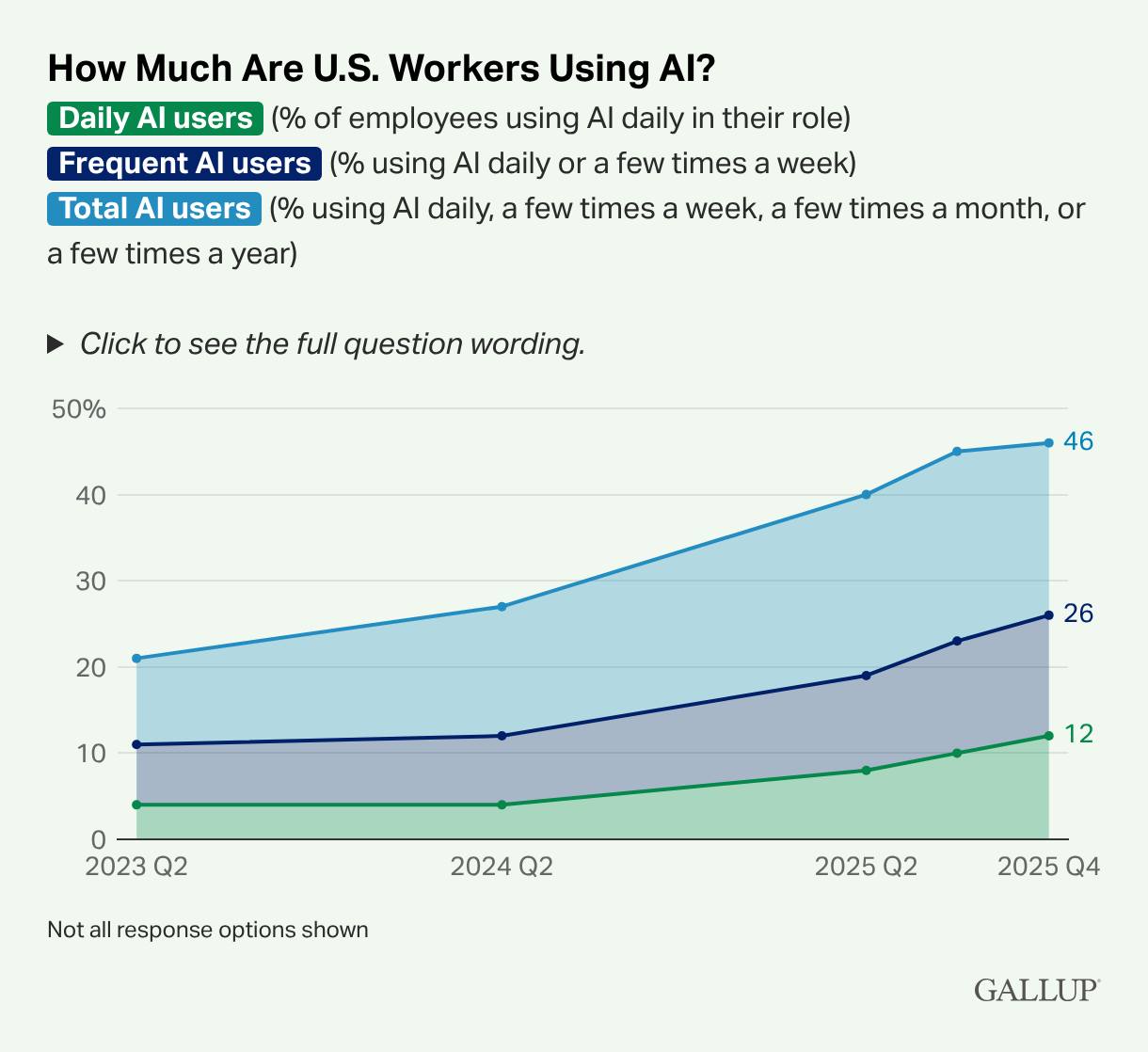
The report, conducted Oct. 30-November 13, 2025, surveyed 22,368 employed U.S. adults in Q4 of 2025.
The rate of daily usage is increasing, but it is really moving in that middle category. Gallup’s trend line shows us that it is really moving from "sometimes" to "a routine". In Q3 2025, 45% of workers used it at least a few times a year, with 10% of them being daily users.
If we look at this overall, the picture becomes even more stark. The mid-2025 figures released by Gallup showed that overall usage had risen from 21% as of 2023 up to 40% as of Q2 2025, with daily usage doubling from 4% to 8% between the two years.
In terms of where AI is becoming routine, Gallup’s Q4 cuts on their data reveal it is concentrated in a few industries, with the largest gaps being between knowledge work and service-oriented jobs.
Technology: 77% total AI use
Finance: 64% total AI use
College or university: 63% total AI use
Professional services: 62% total AI use
K-12 education: 56% total AI use
Retail: 33% total AI use
In intensity, the gap is larger: 31% is daily usage among technology, 16% among professional services, and only 10% among retail.
AP’s reporting around the Gallup release describes using the tools to summarize large amounts of material, to sharpen writing, to speed up response to customers, all of which align with the nature of a desk job.
The desk job edge
The gap between those with desk jobs and those without is growing. Gallup’s most definitive gap is between “remote capable” roles, jobs that could potentially be performed remotely even when the employee is physically at the workplace.
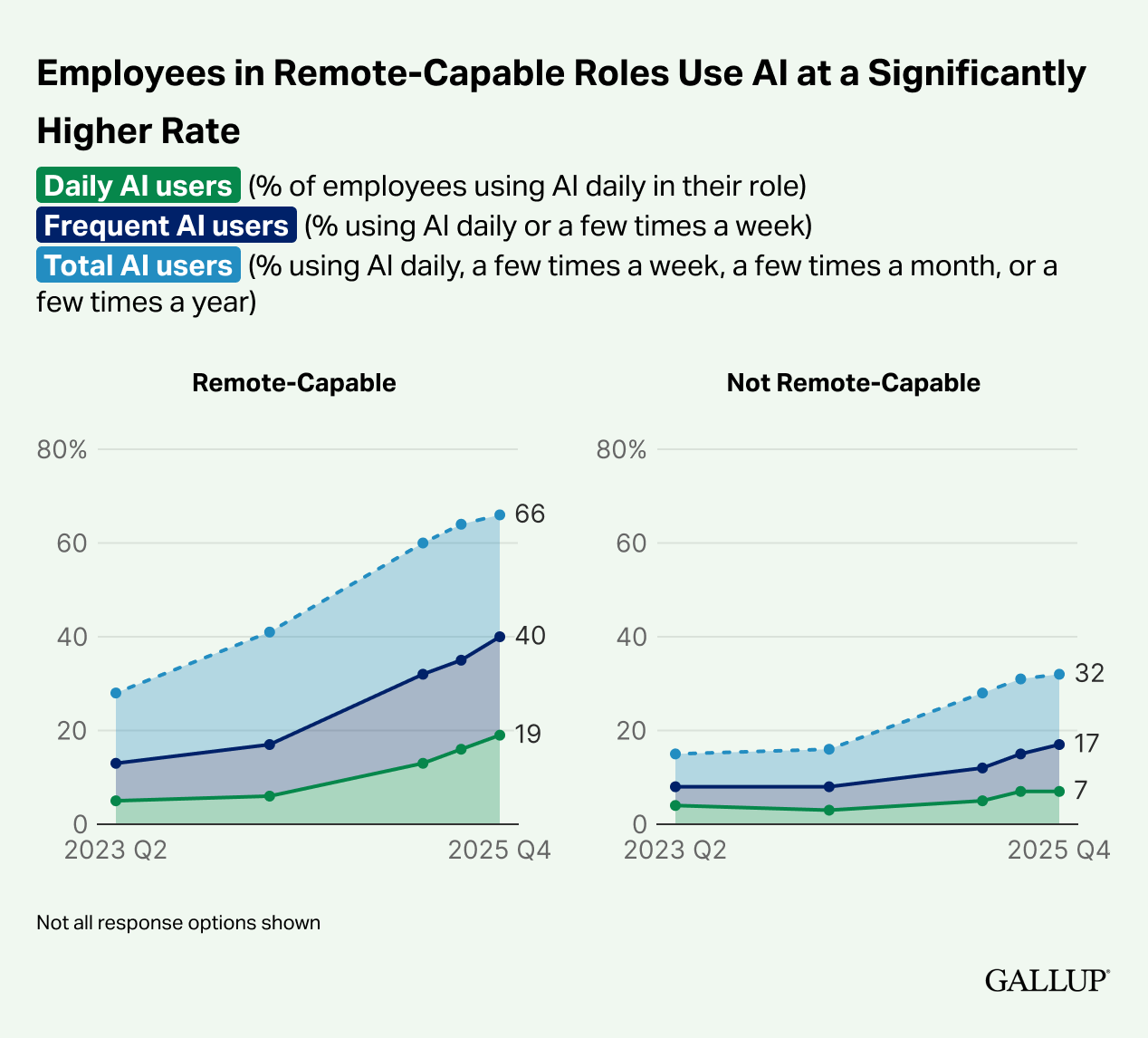
The gap between those using AI daily at their workplaces and those who are not is substantial: 19% of those at workplaces that are remotely capable use AI daily, compared to just 7% in roles that are not remote-capable.
Again, the same pattern is found for the broader split. Two out of every three workers who can work remotely tend to use artificial intelligence at least several times per year, compared to one out of every three workers for those that cannot work remotely.
Hierarchy also increases the gap because, in Q4, leaders reported a higher incidence of using AI, with 69% saying they used it a few times a year or more, compared to 55% of managers and 40% of individual contributors.
However, the tool will not spread if the manager will not support it. Gallup’s most actionable finding is that support, not software, is the conversion layer. Those who strongly agree with the manager supporting the use of AI are 2.1 times as likely to frequently use AI and 6.5 times as likely to strongly agree with the usefulness of the AI tools in the organization.
Gallup also mentions how uncommon it is, as only 28 percent of employees in AI using companies have employees whose managers strongly agree that they support their employees using AI.
The reason so many employees continue to answer "never"
Gallup also asks employees if they think their organization has implemented AI to increase productivity, efficiency, or quality. In Q4, 38% answered "yes", 41% answered "no", and 21% answered "don't know".
The barriers identified by respondents in Q2 2025 when polled by Gallup did not revolve around fear but instead around value. The top response was "none of the above (no barriers)" at 25.4%, unclear use case/value at 16.2%, legal/compliance/privacy at 14.9%, and lack of training at 10.7%.
Of non-users, by far the biggest reason was straightforward: 43.8% of them reported they did not use AI because they did not think it could assist them in their line of work.
But that’s not a lack of adoption by workers. It’s a lack of connection by leadership. It’s a lack of understanding of what “useful and safe” means for a particular task if managers don’t demonstrate that.
What is next, though, as the adoption of this practice increases?
Productivity improvements in these areas, according to Gallup's snapshot of Q4, suggest a near-term answer: productivity improvements lie ahead in jobs already digital, document-based, and done at a desk.
What is next, though, in the longer term, is the future of employees in jobs in which tasks face exposure to artificial intelligence, but the pipeline of opportunities is much thinner.
An analysis done by Brookings puts about 6.1 million workers in a precarious area where they are exposed to AI but have low adaptive capacity. Add that next to Gallup’s “never use” figure. This is where the real danger lies.
The potential cost is not necessarily a missed opportunity for a new tool. It may be a situation where, in some parts of the economy, work is being re-designed to accommodate new technologies, but where sticking to the sidelines may be a silent restriction of options, until a job evolves more quickly than an employee is allowed to.
Y. Anush Reddy is a contributor to this blog.