Google and Walmart launch a new protocol for AI shopping

The next retail power shift is not about who ranks first on a results page. It is about who gets to “complete the purchase” inside the chat window, with the shopper barely lifting a finger.
On January 11, 2026, Google and Walmart announced a new shopping experience that lets people find items, add them to a cart, and check out right inside Gemini and Google’s AI experiences, starting in the U.S. The core piece is the Universal Commerce Protocol (UCP), announced at NRF 2026 in New York.
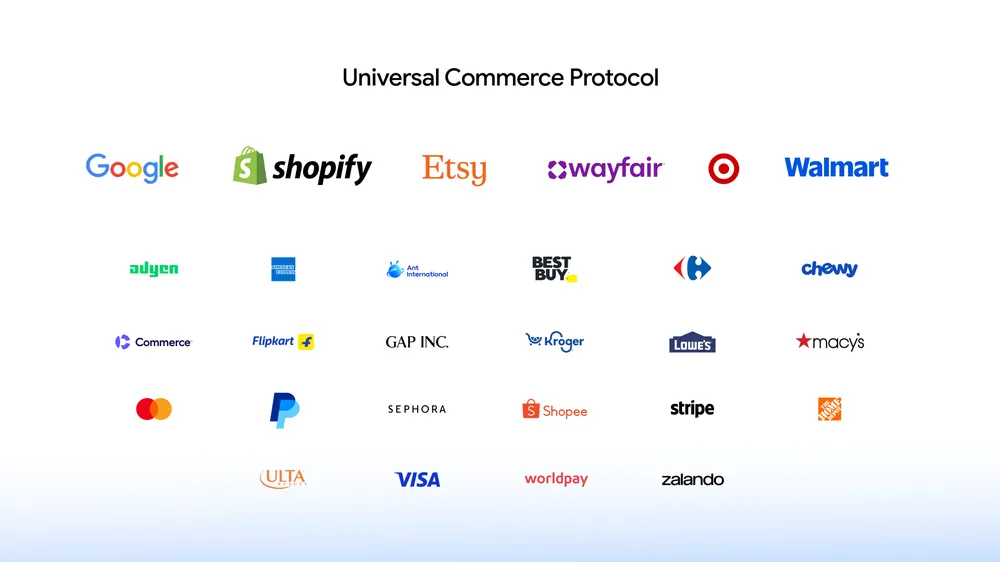
The biggest detail is what UCP is not: it is not a Google-only “retail framework.” Google frames it as an open standard, co-developed with Shopify and Target (plus Walmart, Etsy, Wayfair, and others), and endorsed by 20+ companies across commerce and payments.
UCP is the “bridge,” not a wall
Google says UCP is meant to make retail “agent-ready” across platforms, not tied only to Gemini. In its developer write-up, they call UCP vendor-neutral and say Google’s rollout is the first example, powering checkout in AI Mode and Gemini.
That “open standard” idea feels more credible because of who’s backing it. Google says UCP was built with Shopify, Etsy, Wayfair, Target, and Walmart, and supported by Visa, Mastercard, Stripe, American Express, Adyen, and others.
And this is not just “checkout.” UCP covers the full shopping journey, including post-purchase support.
How “zero-click buying” actually works under the hood
Many retail articles are calling 2026 the year of “zero-click buying,” where discovery and purchase happen in one AI-driven flow. And they are clearly building for that.
Technically, UCP is designed to plug into the new agent stack, not replace it. Google says it works with:
A2A (Agent2Agent) as a transport for agent-to-agent negotiation
MCP (Model Context Protocol) so agents can connect to commerce capabilities without bespoke integrations everywhere
AP2 (Agent Payments Protocol) for secure agentic payments
AP2 matters because “zero-click” shopping falls apart when fraud is disputed. Google says UCP payments are built to prove a user approved the charge using cryptography. AP2 does this with signed “mandates” (like intent or cart approval) that make the user’s consent easy to verify.
Then there is the operational reality: not every transaction can be completed autonomously. Shopify’s engineering deep dive explains a built-in escalation path and the Embedded Checkout Protocol (ECP), where a merchant can return a continue_url when a checkout requires human input. That “human handoff” layer is what makes edge cases workable, like age checks, regulated items, or exceptions that need the buyer to confirm details.
The monetization layer: “Direct Offers” and branded agents
The other half of this story is how Google makes money when fewer people click through to retailer sites.
They announced a new ad format called Direct Offers, positioned as real-time, exclusive discounts shown when the system detects shoppers are close to buying in AI Mode. If “zero-click buying” reduces traditional website traffic, Direct Offers is a clear bet that the conversion moment moves into the assistant, and the ad product follows.
Google also introduced Business Agent, a branded chat on Search that lets retailers answer questions in the brand’s voice. More customization and deeper data connections are planned.
The main point is: Google isn’t just standardizing checkout with UCP, it’s also giving brands ways to keep their identity and control in the chat experience.
Walmart’s move makes the competitive context even sharper. Walmart already partnered with OpenAI on commerce inside ChatGPT, and the OpenAI/Walmart rollout notably left out fresh food at launch.
That makes grocery the industry’s practical test: fresh items, weight-based pricing, and substitutions are where agent checkout gets hard quickly. If UCP can handle that complexity from start to finish, it’s a stronger claim to “infrastructure,” not just a feature.
One more signal that Google is trying to keep this from becoming a Google Pay silo: while Google Pay and Google Wallet are central to the first implementation, they said PayPal support is coming soon, pointing to broader payment interoperability as the roadmap matures.
Y. Anush Reddy is a contributor to this blog.